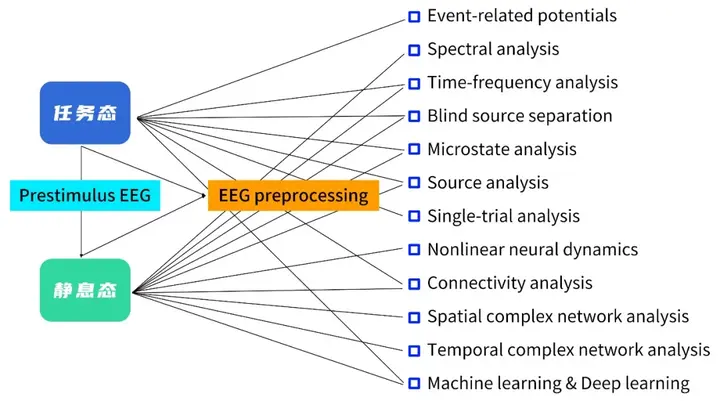
[1]Steven J. Luck (2014). An Introduction to the Event-Related Potential Technique, second edition
[2]Picton, T. W. (1992). The P300 wave of the human event-related potential. Journal of Clinical Neurophysiology
[3]Niedermeyer, E., & da Silva, F. L. (2005). Electroencephalography: Basic principles, clinical applications, and related fields (5th ed.). Lippincott Williams & Wilkins
[4]P Stoica, RL Moses (2005)Spectral analysis of signals
[5]GD Pinna, R Maestri, A Di Cesare - Medical and Biological Engineering …,(1996). Application of time series spectral analysis theory: analysis of cardiovascular variability signals
[6]J.F. Cardoso,d A. Souloumiac(1993). Blind beamforming for non-gaussian signals
[7]Koenig, T., & Melie-García, L. (2010). A method to determine the presence of averaged event-related fields using randomization tests. Brain Topography
[8]PL Nunez, R Srinivasan(2006) Electric fields of the brain: the neurophysics of EEG
[9]Friston, K. J. et al., (1993). Functional connectivity: the principal-component analysis of large (PET) data sets
[10]Philiastides, M. G. & Sajda, P. (2006). Temporal Characterization of the Neural Correlates of Perceptual Decision Making in the Human Brain
[11]Poulsen, A. T., Kamronn, S., Dmochowski, J., Parra, L. C., & Hansen, L. K. (2018). EEG in the classroom: Synchronised neural recordings during video presentation
[12]Breakspear, M., Roberts, J. A., Terry, J. R., Rodrigues, S., & Mahant, N. (2006). A Unifying Explanation of Primary Generalized Seizures Through Nonlinear Brain Modeling and Bifurcation Analysis
[13]Stam, C. J., & van Straaten, E. C. W. (2012). Go with the flow: Use of a directed phase lag index (dPLI) to characterize patterns of phase relations in a large-scale model of brain dynamics
[14]Friston, K. J. (2011). Functional and effective connectivity: A review
[15]Bullmore, E. & Sporns, O. (2009). Complex brain networks: graph theoretical analysis of structural and functional systems
[16]Rubinov, M., & Sporns, O. (2010). Complex network measures of brain connectivity: Uses and interpretations
[17]LeCun, Y., Bengio, Y., & Hinton, G. (2015). Deep learning





 产品展示
产品展示
 http://bitbrain.cn/Zz_www.eastsummit.net/index.html
 销售一部
销售一部